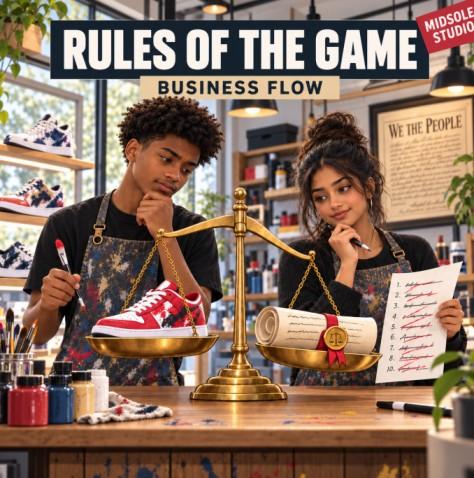
Rules of the Game: Ethics and the sources of law
Rules of the Game: a business law lab on ethics, sources of law and the Bill of Rights
Most business law units teach the sources of law from a chart and ethics from a list of three definitions. Students memorise, test, forget. Rules of the Game teaches the same standards by putting the student inside a business that has to decide something by Saturday.
The story
You are the third founder of Midsole Studio, a custom-sneaker shop opening Saturday. Thursday night your partner Devon texts ten ideas for launch day: call yourselves “the ONLY authentic customs in town,” trade a free pair for five 5-star reviews, sell the customer phone list, give ten percent to the shelter and say so in every ad. Some are clever, some would bring a letter from a federal agency, and several are legal and still make you uneasy. A paralegal named Dana hands you tools instead of answers, and by Saturday morning you write two memos to your partners, what’s legal and what’s right, decide where they disagree, and sign. Students never read “there are four sources of law”; they find out because a rule lands on the shop and someone has to say who wrote it.
What students do
Section 1, Introduction (ethics and the law)
- Vote on all ten ideas by gut, before any teaching, to create a baseline.
- Sort twelve cards into a legal/illegal, right/wrong quadrant and discover that the two axes are different questions.
- Learn the Golden Rule, Greatest Good (utilitarian) and duty-based ethics, then apply all three to a raffle-bot dilemma and to pricing a limited sneaker drop with an interactive price slider that shows sales, complaints and reputation.
- Lock one ethical lens for the shop.
Section 2, Where the law comes from (sources of law, agencies, Bill of Rights)
- Learn to identify who wrote a rule: the people (constitution), a legislature (statute), an agency (regulation) or a judge (case law), using plain-language “tells.”
- Investigate ten real rules in a guess-then-reveal worksheet and build the stack of law.
- Calculate what paying a 16-year-old cousin $6 an hour costs after a Department of Labor audit, including back wages and liquidated damages, and compare federal and state minimum wage.
- Learn the commercial speech test (true, not misleading, legal product) and the Fifth, Sixth and Seventh Amendments as they apply to a business.
- Model an influencer’s undisclosed free-product post against an honest #gifted version and find the break-even point where the FTC risk outweighs the reach.
- Argue both sides of the post before the shop’s paralegal rules.
Section 3, Launch (performance task)
- Write a Legal pass memo: for each idea, legal or illegal, the rule in play, and who wrote it.
- Write a Proud pass memo: for each idea, right or wrong under the shop’s locked lens, with a one-line reason.
- Reconcile the two memos wherever law and ethics disagree, choosing keep, drop or change with a reason, and approve the launch only when every illegal idea is gone.
- Finish with a glossary deck in state-test language, a drag-and-drop vocabulary match, a scenario-based review quiz and a short survey.
Standards covered
The lab covers the ethics and legal-environment objectives that open nearly every state business law course: distinguishing unethical from illegal conduct; the Golden Rule, utilitarian and duty-based ethical theories; the constitutional, statutory, common/case and administrative sources of law; the role of federal agencies including the FTC, FDA, OSHA, EPA and FCC; the Bill of Rights with emphasis on the First Amendment and commercial speech, and the Fifth, Sixth and Seventh Amendments; and federal versus state law. It aligns to NBEA Business Law standards and to the corresponding strands in state frameworks such as Texas TEKS 130.130, Virginia 6135 and Utah Business Law. The two memos and the reconcile task meet the common performance requirement to analyse an ethical business scenario and defend a decision.
Why teachers use it
- Supplemental, not a curriculum: drops into any business law, business management or entrepreneurship unit on ethics and the legal environment. Works with whatever textbook you already use.
- Runs itself: every slide deck is written to the student and read solo; every worksheet carries its own instructions. Teachers review the written reasons, the platform grades the rest.
- Interactive, not reading: sliders, calculators, card sorts, guess-then-reveal investigations and argue-before-the-ruling tasks. Students are never more than ten minutes from a decision.
- Decision-making with reasons: the design rewards a defended choice over an undefended safe one. Students may keep an idea their own ethical rule calls wrong, as long as they write why.
At a glance
Grade level: 9 to 12. Subject: Business Law, Business Management, Entrepreneurship, CTE Business and Marketing. Time: three 50-minute class periods, or about 130 minutes self-paced. Format: individual, online, auto-graded with four teacher-reviewed writing tasks. Includes teacher overview, answer keys, scoring rubric and a vocabulary list of 32 terms.
Keywords: business law lesson plan, ethics vs law activity, sources of law worksheet, Bill of Rights for business, commercial speech lesson, FTC endorsement rules activity, minimum wage calculation worksheet, utilitarianism Golden Rule duty ethics high school, business ethics case study, CTE business law interactive lab.